

If you're worried about seasickness, the good news is that most of it is in your control before you ever board. Book a cabin low and in the middle of the ship, pick a calmer route and season, and if you're prone to motion sickness, talk to your doctor or pharmacist about medication you start before you feel ill. Modern cruise ships are big and stabilized, and plenty of people who get queasy in a car or on a small boat cruise without any trouble. Here's how to stack the odds in your favor.
For what it's worth, I've sailed 14 cruises and have never been seasick myself. The roughest trip I've had was a Western Caribbean cruise out of Galveston during hurricane season. But seasickness can take the fun out of a trip, so it's worth planning for.
Why some places on a ship move more than others
A ship moves in two main ways. It rolls from side to side and it pitches from front to back, like a seesaw. The middle of the ship is the pivot point for pitching, and the lower decks, closer to the waterline, swing less when the ship rolls. That's why every cruise line gives the same advice: the lower you are and the closer to the middle of the ship, the less movement you'll feel.
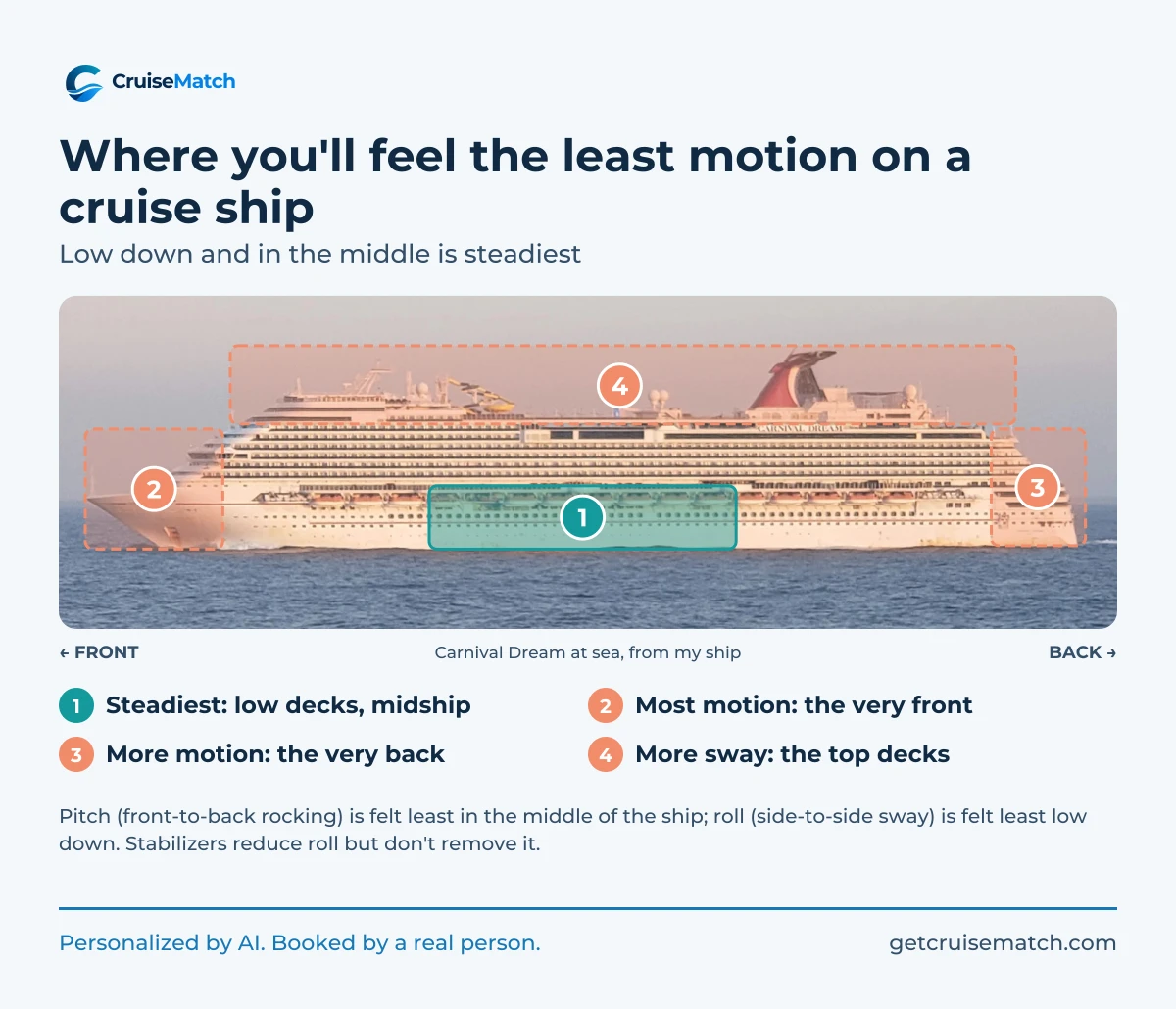
The places that move the most are the very front (the bow), the very back, and the highest decks. Keep that in mind with suites: they're often high up or at the front or back of the ship, which is the opposite of what a motion-sensitive traveler wants.
Every modern cruise ship also has stabilizers: fins that extend from the hull under the water and tilt to push against the roll. They make a big difference, but they reduce rolling rather than eliminate it, so cabin location still matters.
Picking your cabin
- Midship, on a lower deck. This is the single most useful choice. When you book, look at the deck plan and pick a cabin near the elevators in the middle of the ship, on one of the lowest passenger decks.
- Interior or ocean view cabins are often the steadiest. They're usually the lowest and most central rooms on the ship, and the lowest fares, too.
- A balcony helps in a different way. It's usually higher up, but being able to step outside, get fresh air and look at the horizon helps many people feel better quickly. If you'd like a balcony, choose one as low and central as you can.
- Avoid the very front. Forward cabins and the forward-facing suites feel the most pitching when the sea gets up.
I typically book a cabin in the middle of the ship, and I believe it makes a difference.
Picking a calmer route and season
Where and when you sail matters as much as where you sleep.
- The Caribbean and the Bahamas are generally calm, especially outside hurricane season. The Atlantic hurricane season runs from June 1 to November 30, peaking from about mid-August to mid-October. Ships steer around storms, sometimes changing ports, but the seas around a storm can still be rougher than usual.
- Alaska's Inside Passage is sheltered by islands for much of the way, which is why it's often suggested for motion-sensitive cruisers.
- Port days give you a break. A route with more port days and fewer sea days means more time on land, which is a good reason to try a shorter or port-heavy cruise first if you're nervous.
What actually helps
Before you sail:
- Talk to your doctor or pharmacist if you know you're prone to motion sickness. Over-the-counter tablets such as meclizine (Bonine) and dimenhydrinate (Dramamine) are widely used, and there's a prescription patch (scopolamine) that's worn behind the ear and lasts about three days. The patch takes several hours to start working, so it goes on before you board.
- Plan to start medication early. The CDC's advice is that these medicines work best when taken before you're exposed to motion, not after you feel sick. Many of them can make you drowsy, so ask about that, too.
On board:
- Look at the horizon. Keeping your eyes on a fixed, distant point helps your eyes and inner ear agree about what's moving.
- Get fresh air on an open deck or your balcony.
- Head low and central to a lounge or public area in the middle of the ship if your cabin isn't.
- Go easy on alcohol and heavy meals, especially on the first day or two, and keep drinking water.
- Avoid reading or scrolling when the ship is moving a lot.
What about wristbands and ginger? Acupressure bands and ginger are popular, and cruise lines mention them. The evidence is mixed: the CDC says studies haven't found them more effective than a placebo, while the UK's NHS says bands "do not work for everyone". They're cheap and harmless for most people, so if they help you feel better, that's fine. Just don't rely on them alone if you know you get seasick.
If you feel sick on board, most ships have a medical center, and guest services can point you to help. Tell someone sooner rather than later.
What I do: even though I've never been seasick, I pack Bonine or Dramamine on every cruise, just to be safe. Medication affects everyone differently, so ask your doctor about side effects as well as what works.
The bottom line
- Book low and midship; avoid the very front and the highest decks.
- Choose a calmer route and season: the Caribbean outside hurricane season, Alaska's Inside Passage, or a shorter port-heavy trip for a first cruise.
- If you're prone to motion sickness, talk to your doctor or pharmacist before you go and start any medication early.
- On board: horizon, fresh air, light meals, and water.
How CruiseMatch handles this
When you tell CruiseMatch you're worried about seasickness, your stateroom guidance puts motion first: which cabin types and locations tend to feel steadiest, and what to watch out for. We'll never give medical advice, and a doctor or pharmacist is the right person to ask about medication.
Join the launch list to get matched to a cruise, and a cabin, that fits how you travel.
About this guide: this article was researched with AI assistance and checked against public health guidance and cruise lines' published advice as of October 2026. It isn't medical advice; talk to your doctor or pharmacist about medication. CruiseMatch earns a commission from cruise lines when you book with us. It never changes your price, and it plays no part in our recommendations or cost estimates.
Sources
- CDC Yellow Book: Motion sickness
- NHS: Motion sickness
- Royal Caribbean: How do I prevent or treat motion sickness or seasickness?
- Norwegian Cruise Line: 10 ways to keep seasickness at bay while cruising
- NOAA National Hurricane Center: Tropical cyclone climatology
- Wikipedia: Stabilizer (ship)